A door that won’t close. A shelf that needs hanging. A faucet that drips all night. Small jobs like these show up in every home, and they show up at the worst times. Calling a pro for each one adds up fast. The good news is that you can fix most of them yourself if you own the right gear.
This guide covers the best DIY tools every homeowner should have. You don’t need a giant workshop or a huge budget. You need a small set of good tools that you will use again and again. We’ll go through measuring tools, hand tools, power tools, plumbing and electrical basics, painting tools, safety gear, and storage. At the end, you’ll find starter kits for different budgets, common mistakes, and answers to common questions.
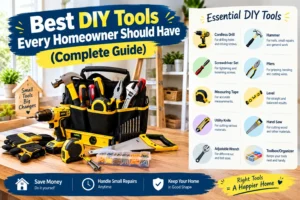
Why Every Homeowner Needs a Basic DIY Tool Kit
Owning a home means something will always need attention. Having your own tools gives you a few big benefits.
You save money: A handyman may charge a service fee just to show up. Tightening a loose hinge or fixing a running toilet takes you ten minutes if you have the right tool. A basic kit often pays for itself after two or three small repairs.
You fix problems faster: A small leak or loose railing can turn into a big, costly problem if you wait. When your tools are in the closet, you can fix things the same day.
You learn useful skills: Every project teaches you something. Hanging a picture teaches you to measure. Replacing a cabinet handle teaches you to use a drill. Over time, you gain the confidence to take on bigger jobs.
You can enjoy the work: Many people find DIY projects relaxing and rewarding. Standing back and looking at something you built or fixed feels great.
How to Choose the Right Tools (Before You Buy)
Before we get to the list, here are a few simple rules that will help you spend wisely.
Buy quality where it counts: Cheap tools can break, slip, or give poor results. Spend a bit more on tools you will use often, like a hammer, a tape measure, and a drill. For tools you’ll use once a year, a budget option is fine.
Start small and grow: You don’t need everything on day one. Buy the basics first. Add more tools when a project calls for them.
Pick comfortable tools: A tool should feel good in your hand. If you can, hold it in the store. Look for rubber or cushioned grips and a good weight.
Stick to one battery brand: If you buy cordless power tools, choose one brand and use its batteries across all tools. This saves a lot of money over time.
Think about storage: Tools you can’t find are tools you can’t use. Plan a spot for them from the start.
Measuring and Marking Tools
Good work starts with good measuring. A cut that is off by half an inch can ruin a whole project. These tools help you get things right the first time.
1. Tape Measure
If you only buy one tool today, make it a tape measure. You’ll use it for hanging shelves, buying furniture, checking a space for an appliance, and nearly every other project.
Look for a 25-foot tape with a wide blade. A wide blade stays straight when you stretch it out, so you can measure alone without it bending. Pick one with a sturdy lock, a clear scale, and a rubber-coated case that can handle a few drops.
Tip: The small hook at the end of the tape is loose on purpose. It slides a little to make up for its own thickness when you hook it on an edge or push it against a wall. Don’t tighten it.
2. Level
A level tells you if something is straight. Without one, shelves lean, pictures hang crooked, and tiles end up uneven. A 24-inch level is a great size for most homes. It’s long enough for shelves and door frames, and short enough to store easily.
You can also buy a small torpedo level, about 9 inches long. It fits in tight spaces and is easy to keep in a toolbox. Many people own both.
Some levels have a built-in laser line or a phone app, but a plain bubble level works well and never needs batteries.
3. Speed Square
A speed square is a small triangle that helps you mark straight lines and perfect 90-degree angles. It’s great for marking cuts on boards. It also works as a guide for your saw. It’s cheap, light, and almost impossible to break.
4. Pencils and a Marker
It sounds simple, but you need good marking tools. Keep a few flat carpenter’s pencils in your kit. They don’t roll off your workbench, and the flat lead makes clear lines. A permanent marker is useful for marking on metal, plastic, and pipes.
5. Stud Finder
Walls are hollow between the wood or metal posts inside them, called studs. If you hang a heavy mirror or TV on drywall alone, it can fall. A stud finder shows you where the studs are so you can screw into something strong.
Basic models beep or light up when they find a stud. Better models can also show wires and pipes behind the wall. Always double-check by drilling a tiny test hole.
Essential Hand Tools
Hand tools are the heart of any toolbox. They never run out of battery, they last for decades, and they handle most small jobs.
6. Claw Hammer
A claw hammer drives nails in and pulls them out. Look for one that weighs between 16 and 20 ounces. That is heavy enough to do real work without tiring your arm. A fiberglass or steel handle with a rubber grip absorbs shock and feels better than a cheap wooden one.
Tip: Hold the handle near the end, not close to the head. You’ll get more power with less effort.
7. Screwdriver Set
You’ll find screws everywhere in a home: on outlet covers, cabinets, furniture, and appliances. A good screwdriver set should include:
- Phillips screwdrivers (the cross-shaped tip) in small, medium, and large sizes
- Flathead screwdrivers (the straight tip) in a few sizes
- Precision screwdrivers for glasses, remote controls, and small electronics
A multi-bit screwdriver is a nice space saver. It holds many tips in one handle. Magnetic tips help hold screws in place so you don’t drop them.
Tip: Always use the right size tip. A tip that is too small or too big will strip the screw head and make it hard to remove.
8. Pliers (Three Types)
Pliers grip, bend, twist, and cut. Most homeowners should own at least three kinds:
- Slip-joint pliers: A general-purpose pair for gripping and turning things.
- Needle-nose pliers: Long, thin tips that reach into tight spots and hold small items like wire or staples.
- Locking pliers (the popular brand name is Vise-Grip): These clamp down and stay locked. They are perfect for gripping a stuck bolt or a rounded nut.
9. Adjustable Wrench
An adjustable wrench has a movable jaw, so one tool fits many bolt sizes. It’s handy for tightening plumbing fittings, assembling furniture, and fixing outdoor equipment. Buy two in different sizes (for example, 6-inch and 10-inch). Using two together is very useful when you need to hold one nut still and turn another.
10. Socket Set
A socket set gives you more grip and turning power than a wrench. It uses a ratchet handle, which lets you turn a nut or bolt without taking the tool off each time. Choose a set with both metric and standard (inch) sizes. Many items, like bikes and imported furniture, use metric, while many older US items use standard.
11. Hex Keys (Allen Wrenches)
Flat-pack furniture almost always comes with a tiny hex key. They’re easy to lose and often poor in quality. A full set of good hex keys, in both metric and standard sizes, makes assembly much easier. They are also used on bicycles, door handles, and faucets.
12. Utility Knife
A utility knife with a retractable blade cuts cardboard, drywall, carpet, rope, tape, and packaging. Pick one with a blade that locks firmly in place. Keep spare blades in the handle. A dull blade is more dangerous than a sharp one because you have to push harder and it can slip.
13. Putty Knife and Scraper
These flat blades are great for spreading filler over holes in walls, scraping off old paint or caulk, and cleaning surfaces. Buy a 1.5-inch and a 3-inch putty knife to cover most jobs.
14. Hand Saw
Even if you own a power saw, a simple hand saw is handy for quick cuts. A small pull saw (also called a Japanese-style saw) cuts on the pull stroke, which gives you more control and a cleaner cut. It works well on trim, small boards, and branches.
15. Clamps
Clamps act like extra hands. They hold wood in place while you cut, drill, or glue. Start with two or four quick-grip bar clamps in a medium size. As your projects grow, you can add more.
16. Chisel Set
A set of wood chisels helps with fitting door hinges, trimming wood, and shaping joints. You may not need these on day one, but they are great for door and cabinet work.
17. Pry Bar and Nail Puller
A pry bar helps you take apart trim, remove old boards, and pull nails. Choose a flat pry bar about 12 inches long, sometimes called a “cat’s paw” or “flat bar.” It can save you hours when you take things apart without damaging the wall.
Must-Have Power Tools
Power tools make jobs faster and easier. You don’t need all of them at once, but a few can change how much you can do at home.
18. Cordless Drill/Driver
If there’s one power tool that earns its place in every home, it’s the cordless drill. It drills holes and drives screws, and it can do so much more with the right accessories.
What to look for:
- Voltage: An 18V or 20V model gives plenty of power for home use.
- Clutch settings: This stops the drill from over-tightening screws.
- Two batteries: One can charge while you work with the other.
- LED light: This helps in dark corners and under cabinets.
Get a drill bit set and a screwdriver bit set to go with it. A basic set of bits in different sizes will handle wood, metal, and light masonry.
19. Impact Driver
An impact driver looks like a drill, but it works differently. It uses quick, strong bursts to drive long screws and bolts with little effort. It’s great for building decks, fences, and shelves. It’s not a must-have at the start, but many homeowners find it’s the next best tool to add after a drill.
20. Circular Saw
A circular saw makes long, straight cuts in wood. It’s the best choice for cutting plywood, 2x4s, and decking boards. A 7¼-inch cordless model is a good size for most homeowners. Always clamp your wood and wear eye protection when using one.
21. Jigsaw
A jigsaw cuts curves and odd shapes. You can use it to cut a hole in a countertop for a sink or to shape a piece of wood for a craft project. With the right blade, it can also cut metal and plastic.
22. Oscillating Multi-Tool
This tool vibrates back and forth very fast and works with many different attachments. It can cut off a nail flush with a surface, trim a door frame so new flooring slides under it, sand in tight corners, and scrape off old grout. It might sound like a gadget, but many DIYers say it’s one of their most-used tools.
23. Random Orbital Sander
Sanding by hand takes a long time and makes your arm tired. A random orbital sander smooths wood quickly and leaves no deep scratch marks. It’s great for refinishing furniture, preparing walls or doors for paint, and finishing wood projects. Start with a 5-inch model and a pack of sandpaper in different grits (the number tells you how rough it is: low numbers are coarse, high numbers are fine).
24. Shop Vacuum (Wet/Dry Vac)
DIY work makes dust and dirt. A wet/dry vacuum cleans up sawdust, drywall dust, spilled water, and more. It can even be used to clear a clogged drain in a pinch. A 5- to 8-gallon model is plenty for most homes.
25. Heat Gun (Optional)
A heat gun softens old paint for easier removal, bends plastic pipes, and helps remove stickers. It’s not essential, but it’s useful for certain projects.
Plumbing Tools Every Homeowner Should Have
A leaky pipe or a clogged drain can cause a lot of stress. A few simple plumbing tools let you solve many common problems without a plumber.
26. Plunger (Two Types)
A cup plunger works on sinks and tubs. A flange plunger, which has an extra rubber piece sticking out of the bottom, works best on toilets. Keeping both on hand means you’re ready for most clogs.
27. Drain Snake (Auger)
When a plunger doesn’t work, a drain snake can reach deeper into the pipe and break up or pull out the clog. A basic 25-foot hand-crank model works for most sink and shower clogs. Plastic drain-cleaning strips are cheap and handy for hair clogs.
28. Pipe Wrench
A pipe wrench has strong, toothed jaws that grip round pipes. It’s the right tool for turning metal pipes and big fittings. An 14-inch model covers most home jobs.
29. Plumber’s Tape (Thread Seal Tape)
This thin white tape wraps around pipe threads to help them seal and prevent leaks. It costs very little and is great for fixing small drips on shower heads, hose connections, and faucets.
30. Basin Wrench
If you want to replace a kitchen or bathroom faucet, a basin wrench is a lifesaver. It reaches up behind the sink where your hand and normal wrenches can’t go.
Electrical Tools for Safe DIY Work
Electrical work can be dangerous. Always turn off the power at the breaker box first, and call a licensed electrician for anything big or anything you’re unsure about. For small jobs, a few tools make things safer and easier.
31. Non-Contact Voltage Tester
This pen-sized tool beeps or lights up when it finds live electricity. Before you touch any wire, outlet, or switch, check it with a voltage tester. It’s inexpensive and could save your life.
32. Wire Stripper and Cutter
A wire stripper removes the plastic coating from a wire without cutting the metal inside. You’ll need it to replace a light fixture, switch, or outlet. A good one has clearly marked wire sizes.
33. Multimeter
A multimeter measures voltage, current, and resistance. It helps you find out whether an outlet is working, whether a battery is dead, or whether a cord is broken. You don’t need a fancy one. A basic digital multimeter is enough for home use.
34. Electrical Tape
Electrical tape wraps and protects wire connections. Keep a couple of rolls on hand. Buy a good brand because cheap tape can dry out and peel.
Painting and Finishing Tools
A fresh coat of paint is one of the cheapest ways to improve a room. The right tools make the job faster and give a much better finish.
35. Paint Brushes and Rollers
Buy a good angled brush (2 to 2.5 inches) for cutting in along edges and corners, and a roller with a few extra roller covers for big walls. Good brushes hold more paint, leave fewer streaks, and last for years if you clean them well.
36. Paint Tray and Liners
A tray holds paint for your roller. Disposable liners make cleanup quick.
37. Painter’s Tape
Painter’s tape makes clean, sharp lines along trim, ceilings, and windows. It peels off easily without damaging the surface underneath. Remove it while the paint is still a little wet for the cleanest edge.
38. Drop Cloths
Protect your floors and furniture from drips and spills. Canvas drop cloths are reusable and don’t slip, while thin plastic ones are cheaper but can be slippery.
39. Caulk Gun and Caulk
Caulk seals gaps around tubs, sinks, windows, and trim. It stops water, drafts, and bugs. A caulk gun with a smooth trigger gives you control. A silicone caulk works well in wet areas, and a paintable acrylic caulk is better for trim and walls.
40. Sandpaper and Sanding Blocks
Even if you own a power sander, keep a stack of sandpaper and a sanding block for small areas and touch-ups.
Safety Gear You Should Never Skip
The best tool in your box is the one that keeps you safe. Many DIY injuries happen because people skip simple protection. Make these items part of your kit from the start.
41. Safety Glasses
Flying dust, chips, and splinters can hurt your eyes in a second. Wear safety glasses every time you cut, drill, sand, or hammer. Pick a pair that is comfortable so you’ll actually wear it.
42. Work Gloves
Gloves protect your hands from cuts, blisters, and splinters. Keep one pair for general work and a pair of heavy-duty gloves for rough jobs. Remember to take gloves off when using some spinning tools, like a drill press, because they can get caught.
43. Ear Protection
Power saws, sanders, and shop vacuums are loud. Over time, loud noise can damage your hearing. Foam earplugs or earmuffs are cheap and easy to use.
44. Dust Mask or Respirator
Sanding, cutting drywall, and cleaning up dust can send tiny particles into your lungs. A simple dust mask helps for light jobs. For painting, working with chemicals, or heavy dust, use a respirator with the right filters.
45. First Aid Kit
Keep a well-stocked first aid kit near your work area. Cuts, scrapes, and splinters happen even to careful people.
46. Fire Extinguisher
Keep one in your garage or workshop, and make sure everyone knows where it is. Check the gauge now and then to make sure it’s charged.
47. Sturdy Ladder
A good ladder lets you reach high spots safely. A 6-foot step ladder works well indoors, and a multi-position ladder covers more jobs. Always check the weight rating, place it on flat ground, and never stand on the top step.
Storage and Organization Tools
A tidy toolbox saves time and keeps your tools in good shape.
Toolbox or tool bag: Keep your everyday hand tools together in one place so you can carry them to the job.
Wall pegboard or shelves: A pegboard in the garage keeps tools in view and easy to grab.
Small parts organizer: Screws, nails, anchors, and washers get lost easily. Clear plastic organizers with small compartments keep them sorted.
Workbench: A sturdy bench gives you a flat, stable place to cut, assemble, and repair. A folding workbench is a great choice if you’re short on space.
Label everything: A little time spent labeling bins and drawers will save you lots of searching later.
Handy Extras Worth Having
These small items aren’t “tools” in the usual sense, but you’ll be glad you own them:
- Flashlight or headlamp: Great for dark attics, basements, and under sinks. A headlamp keeps both hands free.
- Extension cord: Choose a heavy-duty one for power tools.
- Zip ties and duct tape: Quick fixes for many small problems.
- Wood glue and super glue: For repairs and small projects.
- Assorted screws, nails, and wall anchors: Having a variety on hand means fewer trips to the store.
- WD-40 or similar lubricant: Silences squeaky hinges and frees stuck parts.
- Stepladder or step stool: Perfect for quick reach jobs around the house.
Starter Tool Kits by Budget
Not sure where to begin? Here are three simple paths. Choose the one that fits your needs and grow from there.
The Beginner Kit (Just the Basics)
- Tape measure
- Claw hammer
- Screwdriver set
- Pliers (slip-joint and needle-nose)
- Adjustable wrench
- Utility knife
- Level
- Safety glasses and work gloves
- Cordless drill with bit set
This small set handles most tasks like hanging pictures, building flat-pack furniture, tightening fittings, and simple repairs.
The Intermediate Kit (Ready for Bigger Jobs)
Add to the beginner kit:
- Socket set
- Hex key set
- Hand saw
- Clamps
- Stud finder
- Caulk gun
- Putty knife
- Impact driver
- Circular saw or jigsaw
- Plunger and drain snake
- Voltage tester
You can now install shelves, replace faucets, fix drywall, and handle many weekend projects.
The Advanced Kit (Serious DIYer)
Add to the intermediate kit:
- Oscillating multi-tool
- Random orbital sander
- Wet/dry vacuum
- Multimeter and wire strippers
- Pipe wrench and basin wrench
- Chisel set
- Workbench
- Extra batteries and a fast charger
- Ladder
With this kit, you can take on remodeling projects like building decks, installing trim, and refinishing floors.
Common Mistakes to Avoid When Buying DIY Tools
Buying a huge kit just because it looks like a deal: Giant “200-piece” sets often include many tools you’ll never use and some of low quality. It’s usually better to buy fewer, better pieces.
Choosing price over quality for key tools: The cheapest tape measure, drill, or hammer may cost you more in the long run if it breaks or gives poor results.
Mixing battery brands: This leads to a pile of chargers and batteries that can’t be shared.
Skipping safety gear: A pair of glasses costs very little compared to an emergency room visit.
Not reading the manual: Every power tool has rules for safe use. A few minutes of reading can prevent injury and damage.
Forgetting about storage: Tools left in damp spots or tossed in a pile can rust, dull, or get lost.
Taking on jobs that are too big: DIY is great, but some jobs, like major electrical work, gas lines, and structural changes, need a licensed professional. Know your limits.
How to Take Care of Your Tools
Good tools can last a lifetime if you look after them.
- Keep them clean and dry: Wipe tools after use. Moisture causes rust.
- Store them properly: Use a toolbox, drawer, or wall rack in a dry spot.
- Sharpen blades: Dull saws, chisels, and knives are harder and riskier to use.
- Oil moving parts: A drop of light oil on hinges, pliers, and wrench jaws keeps them smooth.
- Care for batteries: Don’t leave lithium batteries in a hot car or a freezing garage. Store them with a partial charge if you won’t use them for a while.
- Check cords and plugs: Replace any damaged cords before using a corded tool again.
- Put tools back after each job: It’s the simplest habit and the one that saves the most time.
Where to Buy and How to Save Money
You don’t have to pay full price for everything.
- Home improvement stores: Often run seasonal sales, especially around holidays.
- Tool combo kits: Buying a drill, impact driver, and batteries together is often cheaper than buying them one by one.
- Used tools: Garage sales, online marketplaces, and secondhand shops can have great deals, especially on hand tools. Check that everything works.
- Tool rental: For rarely used or large tools, such as a tile saw or floor sander, renting is smarter than buying.
- Borrow from neighbors: Ask friends and family. Just return the favor and the tool in good shape.
- Read reviews: Check what real users say about durability and ease of use before you buy.
Frequently Asked Questions
What are the first DIY tools a homeowner should buy?
Start with a tape measure, hammer, screwdriver set, pliers, adjustable wrench, utility knife, level, and a cordless drill. Add safety glasses and work gloves too. These cover most small household jobs.
How much does it cost to build a basic DIY tool kit?
It depends on the brands and quality you choose. You can build a basic starter kit with a modest budget, then add tools slowly as projects come up. Watch for sales and combo kits to save more.
Should I buy cordless or corded power tools?
For most homeowners, cordless tools are the better choice. They’re easier to move, safer to use without a cord in the way, and powerful enough for home projects. Corded tools can still make sense for heavy, long-running jobs.
Is it worth buying expensive tools?
For tools you use often, yes. A better drill or tape measure will last longer and work better. For tools you use once in a while, a cheaper or rented option is usually fine.
What DIY tools do I need to hang shelves and pictures?
You’ll need a tape measure, level, pencil, stud finder, drill, screwdriver, and the right wall anchors or screws for your wall type.
What tools should every homeowner have for plumbing?
A plunger, drain snake, adjustable wrench, pipe wrench, and plumber’s tape handle many common problems like clogs and small leaks.
What safety gear is most important?
Safety glasses, work gloves, ear protection, and a dust mask are the basics. Add a first aid kit and fire extinguisher for your work area.
How do I know when to call a professional?
Call a pro for major electrical work, gas lines, structural changes, roof repairs at height, or any job where a mistake could cause serious harm or costly damage. If you feel unsure, it’s wise to ask an expert.
Final Thoughts
Building a home tool kit doesn’t have to be hard or expensive. Start with the simple basics: a tape measure, hammer, screwdrivers, pliers, wrench, level, utility knife, and a good cordless drill. Add safety gear right away. Then grow your collection as new projects appear.
The best DIY tools every homeowner should have are the ones that fit your home, your skills, and your goals. Buy quality where it counts, keep your tools clean and organized, and always put safety first. With a good set of tools and a little practice, you’ll fix problems faster, save money, and feel proud of the work you do around your home.
So pick a small project this weekend, grab your tools, and get started. Your home will thank you.