Do you look around your home and feel tired just from seeing all the stuff? Maybe your shelves are full, your closet won’t close, and your living room feels busy instead of relaxing. If this sounds like you, minimalism might be exactly what you need.
This guide is made for people who are just starting out. You will not find fancy words or hard design terms here. Instead, you will find simple, easy-to-follow minimalist home decor ideas for beginners that anyone can use, no matter your budget or the size of your home.
By the end of this post, you will know what minimalism really means, how to begin, which rooms to start with, what colors and furniture to choose, and how to keep your home simple for the long run.
Let’s get started.
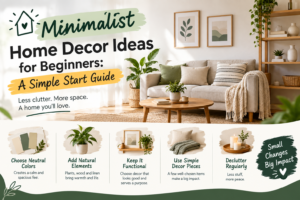
What Does “Minimalist Home Decor” Really Mean?
Many people think minimalism means having an empty house with just one white chair and nothing else. That is not true.
Minimalist home decor simply means keeping only the things you truly need or truly love, and removing everything else. It’s about quality over quantity. Instead of having ten cheap items, you keep two or three good ones that actually make you happy or serve a purpose.
A minimalist home is:
- Clean and open, with room to breathe
- Simple in color and design
- Full of things that are useful or meaningful
- Free from clutter and random items lying around
A minimalist home is NOT:
- Cold, empty, or boring
- A house with no personality
- Something only rich people can do
- A one-time task you finish and forget
Minimalism is more like a habit. Once you start, it becomes a lifestyle that makes your home peaceful and easier to clean.
Why Should Beginners Try Minimalist Decor?
Before jumping into the tips, let’s talk about why this style is so popular, especially among people just starting to decorate their own space.
1. It saves money
When you buy fewer things, and only the ones you really need, you spend less. You stop buying random decorations just because they look cute at the store.
2. It saves time
A home with fewer items is faster to clean. No need to dust ten shelves full of small objects. Less stuff means less time spent tidying up every day.
3. It reduces stress
Studies and real-life experience show that clutter can make us feel anxious. A clean, simple space can help your mind feel calm the moment you walk in.
4. It looks good in photos and in person
Minimalist homes often look more elegant and put-together, even with very little effort, because everything has its own space and purpose.
5. It’s beginner-friendly
Unlike some design styles that need special skills or expensive pieces, minimalism is about doing less. That makes it one of the easiest styles for someone who has never decorated before.
Step 1: Start With Decluttering, Not Decorating
The biggest mistake beginners make is going straight to buying new decor items. But minimalism doesn’t start with shopping — it starts with clearing out what you already have.
Here’s a simple way to declutter as a beginner:
Go room by room.
Don’t try to do your whole house in one day. Pick one room, or even one corner, and focus only on that space.
Use the three-box method.
Get three boxes or bags and label them:
- Keep
- Donate or sell
- Throw away
As you go through your things, place each item into one of these three boxes. Don’t overthink it. If you haven’t used something in the past year, and it doesn’t hold real meaning for you, it probably belongs in the donate or throw-away box.
Ask simple questions.
For each item, ask yourself:
- Do I use this often?
- Does this item make my life easier?
- Do I truly love it, or am I just keeping it out of habit?
If the answer to all of these is no, let it go.
Don’t rush, but don’t stop either.
Decluttering can feel emotional, especially with items that have memories attached. Take your time, but try to finish one area before moving to the next so you don’t lose momentum.
Step 2: Choose a Simple Color Palette
Color plays a huge role in how “minimal” your home feels. A messy mix of bright colors can make even an empty room feel busy.
For beginners, the easiest approach is to pick one main color and one or two supporting colors.
Popular minimalist color choices include:
- Soft white or off-white
- Light beige or sand
- Warm gray
- Soft brown or wood tones
These colors are calming, timeless, and easy to match with almost any furniture or decor piece you add later.
Simple tip: Instead of painting every wall a different bright color, try using one neutral color throughout your home. This creates a smooth, connected flow from room to room, which is one of the easiest minimalist home decor ideas for beginners to apply right away.
You don’t have to avoid color completely. You can add one small accent color, like a soft green plant, a navy blue pillow, or a black picture frame. Just keep it limited so it doesn’t take over the space.
Step 3: Pick Furniture That Does More Than One Job
In a minimalist home, every piece of furniture should have a clear purpose. Beginners often make the mistake of filling rooms with furniture just because there’s empty space to fill.
Instead, try this rule: if a piece of furniture isn’t useful or beautiful, it probably doesn’t belong.
Here are some easy furniture ideas:
- A storage bed instead of a regular bed, so you can store extra blankets or clothes underneath
- A coffee table with a shelf underneath for books or remotes
- A bench with storage near the entryway for shoes
- Nesting tables that save space when not in use
- Simple shelves instead of large bulky cabinets
When shopping for furniture, look for clean, simple shapes. Avoid pieces with lots of carving, patterns, or shiny material. Straight lines and soft curves work best in a minimalist setting.
Step 4: Learn the “One In, One Out” Rule
This is one of the simplest and most powerful minimalist home decor ideas for beginners, and it’s something you can use forever.
The rule is easy: whenever you bring something new into your home, remove something old.
For example:
- If you buy a new shirt, donate an old one.
- If you get a new mug, give away one you don’t use.
- If you bring in a new decoration, remove another from that same shelf.
This habit stops your home from slowly filling up with stuff again after you’ve worked hard to declutter it. It keeps your home in balance without much effort.
Step 5: Give Every Item a “Home”
A big part of a clean, minimal look is knowing where everything belongs. When every item has its own place, your home naturally looks tidy, because things are less likely to end up scattered around.
Try this simple method:
- Keep keys and mail in one small tray by the door
- Store shoes in a rack or shelf, not on the floor
- Give each room a specific spot for remote controls, chargers, or books
- Use small baskets or boxes to organize drawers
When everything has a “home,” cleaning up becomes a two-minute job instead of a big task.
Step 6: Keep Wall Decor Simple
Walls are one of the easiest places to overdo it. Beginners often fill every wall with frames, art, and shelves, which can make a room feel busy even if the furniture is simple.
Here are some easy wall decor tips:
- Choose one large piece of art instead of five small ones
- Leave some wall space empty — this is called “negative space,” and it actually makes a room feel more open and calm
- Stick to a simple color theme for any frames or art you hang
- Avoid mixing too many photo sizes and styles on one wall
If you love photos or personal items, try rotating them instead of showing everything at once. Keep a few out and store the rest, then switch them every few months.
Step 7: Let Natural Light and Plants Do the Work
Minimalist homes often look bright, fresh, and alive, even without lots of decoration. Two of the easiest tools to create this feeling are natural light and plants.
Light:
- Use light, thin curtains instead of heavy, dark ones
- Avoid blocking windows with furniture
- Add a simple lamp with a warm light for evenings
Plants:
A single healthy plant can add more life to a room than ten small decorations. Good easy options for beginners include:
- Snake plant
- Pothos
- Peace lily
These plants are low-maintenance and don’t need much sunlight or watering, which makes them perfect for beginners who are new to both decorating and plant care.
Step 8: Focus on Texture, Not Just Objects
Since minimalist rooms often use fewer colors and items, texture becomes very important. Texture means how something feels or looks — smooth, rough, soft, or shiny.
Simple ways to add texture without adding clutter:
- A soft wool or knit blanket on the couch
- A jute or woven rug on the floor
- Wooden furniture with visible natural grain
- Linen curtains or pillow covers
These small touches make a room feel warm and cozy, even though the color palette and item count stay simple.
Step 9: Don’t Forget the Kitchen and Bathroom
Many beginners focus only on the living room or bedroom, but the kitchen and bathroom can easily become cluttered too.
Kitchen tips:
- Keep countertops mostly empty. Only leave out items you use every single day, like a coffee maker
- Store small appliances in cabinets when not in use
- Use matching containers for things like flour, sugar, or pasta
Bathroom tips:
- Store toiletries in a drawer or cabinet instead of leaving them on the counter
- Use a small tray for the few items you use daily, like toothbrush and soap
- Keep towels folded neatly in one simple color
A simple, empty countertop instantly makes any kitchen or bathroom feel more minimal and clean.
Step 10: Build Slowly — Minimalism Is Not a Race
One thing many beginners don’t realize is that minimalism doesn’t need to happen overnight. You don’t have to throw everything away in one weekend or buy new furniture all at once.
Instead, treat it as a slow, steady process:
- Start with one room
- Remove a few items each week
- Only buy new things when you’re sure you need them
- Notice how your home feels as you go, and adjust from there
This slow approach is actually one of the best minimalist home decor ideas for beginners, because it avoids stress and helps the habit stick for the long term, instead of feeling like a short trend you’ll give up on.
Common Mistakes Beginners Should Avoid
Even with good intentions, it’s easy to make small mistakes when starting out. Here are a few to watch for:
1. Buying new “minimalist” items right away
Ironically, some beginners end up buying a lot of new things just to make their home “look” minimal. Remember, minimalism is about using less, not buying more.
2. Making the home feel cold and empty
Removing too much without adding warmth (like plants, soft textures, or wood tones) can make a space feel unwelcoming. Balance is key.
3. Trying to do everything in one day
This often leads to burnout. Take it room by room, or even shelf by shelf.
4. Ignoring personal style
Minimalism doesn’t mean removing your personality. You can still keep a few meaningful items — just be selective about what you display.
5. Forgetting hidden storage spaces
Clutter often hides in drawers, closets, or under the bed. A home can look clean on the surface but still feel cluttered because of what’s hidden away. Don’t skip these spaces when decluttering.
A Simple Beginner’s Checklist
To make things even easier, here is a short checklist you can follow as you start your minimalist journey:
- Pick one room to start with
- Use the three-box method to sort items
- Choose one main color and one or two supporting colors
- Remove furniture that doesn’t serve a clear purpose
- Give every item a specific “home”
- Simplify wall decor — less is more
- Add natural light and one or two easy plants
- Add texture through blankets, rugs, or wood
- Declutter kitchen counters and bathroom surfaces
- Apply the “one in, one out” rule going forward
Print this list or save it somewhere you’ll see it often. Checking off small tasks over time will keep you motivated without feeling overwhelmed.
Final Thoughts
Starting a minimalist home doesn’t require expensive furniture, professional design skills, or a complete home makeover. It simply requires the willingness to slow down, remove what you don’t need, and keep only what truly adds value to your life.
These minimalist home decor ideas for beginners are meant to be a starting point, not a strict rulebook. Every home and every person is different, so feel free to adjust these tips to match your own comfort and taste. The goal isn’t a perfectly empty house — it’s a home that feels calm, easy to manage, and truly yours.
Start small. Pick one room today. And take your first step toward a simpler, more peaceful home.